
Let’s be honest—most business owners don’t have a “sales problem.”
They have a cashflow problem.
You can be fully booked, working nonstop, and still feel like your bank account is playing hide-and-seek. And that’s not because you’re “bad at business.” It’s usually because your money is leaking in predictable places—and nobody taught you where to look.
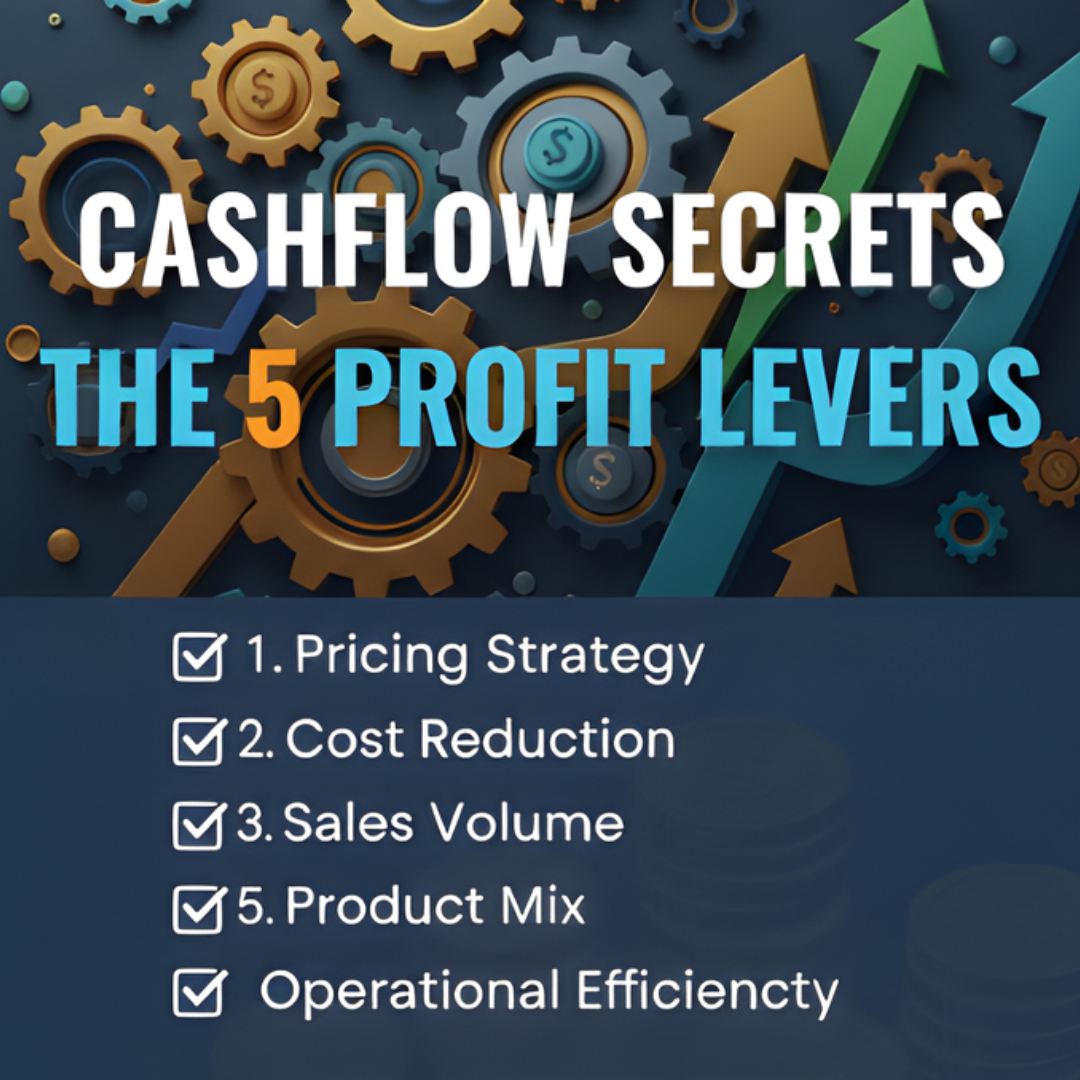
So here’s what we’re going to do today: I’ll walk you through 5 profit levers you can pull to improve cash flow and increase business profit—without adding more hours to your week.
Think of these levers like the knobs on a sound system. You don’t need a whole new stereo. You just need to turn the right knobs, in the right order.
By the end of this blog, you’ll know:
- The 5 levers that control most of your cash flow,
- what to tweak first (quick wins),
- and simple actions you can take this week to put money back in your pocket.
And while you’re reading, I’ll ask you a few questions—because I want this to feel like coaching, not a lecture.
First: What Cash Flow Really Means (No Jargon, Promise)
Cash flow is the timing of money coming in and money going out.
Profit on paper doesn’t pay bills if the cash arrives late.
That’s why cash flow management is less about “working harder” and more about running smarter.
Quick question:
Do you feel the pain more in “not enough sales”… or “sales come in but money disappears”?
Drop it in the comments—I read them and I reply.
The 5 Profit Levers (Your Cashflow Control Panel)
Here’s the big idea: You don’t need 20 strategies.
You need 5 levers—and a habit of pulling them monthly.
Lever 1: Pricing (The Fastest Way to Increase Profit Margin)
If you only read one section, read this one.
A small price increase can create a surprisingly big jump in profit—because your costs don’t rise at the same rate.
What most owners do
They keep prices low “to stay competitive,” then try to survive on volume… which usually means longer hours.
What a coach wants you to do instead
Increase price strategically, with a clear reason and clear value.
Simple pricing moves that improve cash flow:
- Raise prices for your highest-demand offer.
- Remove “custom everything” unless it’s priced as premium.
- Add a premium option (so clients self-select into higher value).
- Tie your price to outcomes, not hours.
Conversation check:
When was the last time you raised your prices—six months ago, a year ago, or never?
Quick win:
Pick ONE offer and add 5–10% with better positioning (not apologizing).
If you’re nervous, do it for new clients first.
Lever 2: Sales Volume (But Without Hustle Mode)
Yes, more sales can improve cash flow. But “more sales” doesn’t always mean “more work.”
The trick is focusing on easier-to-win volume, not exhausting volume.
Low-effort ways to increase sales volume:
- Follow up with warm leads (most revenue is hiding in follow-ups).
- Reactivate past clients with a simple check-in offer.
- Create a “next step” offer so buyers don’t disappear after one purchase.
Example (simple and effective):
“Hey [Name], quick one—do you want help fixing [specific problem] this month? I opened 3 spots.”
That’s it. No essay. No begging.
Cash flow management tip:
If you don’t have a consistent follow-up system, you don’t have a sales system—you have a hope system.
Lever 3: Average Order Value (Make Each Sale Worth More)
If your business is busy but cash is tight, you probably need this lever.
Average order value means: when someone buys, how much do they spend?
Easy ways to increase average order value:
- Bundle your best services/products (people pay more for “complete”).
- Add an upsell that saves them time.
- Offer a “done-with-you” add-on for people who don’t want DIY.
- Build packages around the customer journey (start → fix → maintain).
Real talk:
Selling more to the same customer is usually easier than constantly finding new customers.
Quick win:
Add ONE add-on that complements your main offer.
Price it so it’s an easy “yes” (not a whole new decision).
Lever 4: Costs (Stop Bleeding Money Quietly)
This lever has two parts:
- Direct costs (what it costs to deliver the product/service)
- Overhead (tools, subscriptions, rent, admin, “business expenses”)
The mistake
Owners cut the wrong costs first—like marketing—then wonder why sales drop.
The smarter move
Cut costs that don’t move revenue, quality, or delivery speed.
Cashflow secrets in cost control:
- Cancel tools you “might use someday.”
- Negotiate with suppliers (yes, you can ask).
- Tighten your process so you deliver faster with fewer steps.
- Track your top 5 expenses monthly (not yearly).
Quick gut-check:
Do you know your profit margin per offer?
If not, you’re guessing—and guessing is expensive.
Quick win:
List every subscription and label it:
- Makes money
- Saves time
- Nice to have
- Cut the “nice to have” ones today.
Lever 5: Collections + Cash Timing (Get Paid Faster)
This is the most ignored lever in small business cash flow—and it’s often the most powerful.
You can be profitable and still broke if:
- clients pay late,
- you pay vendors too early,
- or your payment terms are too loose.
Simple ways to improve cash flow fast:
- Require deposits (or pay-in-full for smaller projects).
- Shorten payment terms (Net 30 → Net 7 or due on receipt).
- Use autopay for retainers and memberships.
- Incentivize early payment (small bonus, small discount, priority).
- Penalize late payment (clearly written, consistently applied).
Example policy wording (clear, not aggressive):
“Invoices are due within 7 days. Work resumes once payment is received.”
Quick win:
Pick ONE offer and add:
- 50% upfront, 50% on delivery (or milestones), OR
- pay-in-full with a small “fast action” bonus
The Order Matters: Pull These Levers in This Sequence
If you try to fix everything at once, you’ll do nothing consistently. So here’s the order I’d coach you to follow:
- Collections / cash timing (fastest impact)
- Pricing (big profit lift without extra work)
- Costs (stop the leaks)
- Average order value (make each sale count)
- Sales volume (scale what’s already working)
This sequence works because it prioritizes speed + impact—like plugging leaks before pouring more water.
A Simple 15-Minute Cash Flow Audit (Do This This Week)
Open your notes and answer these:
- What offer makes you the most money per hour?
- Which offer creates the most stress for the least profit?
- What are your top 5 expenses?
- How fast do you get paid (average days)?
- What would change if you raised prices 10%?
If you want, share your answers in the comments (even partial). I’ll reply with which lever you should pull first.
Common Objections I Hear (And My Coach Answer)
“If I raise prices, I’ll lose customers.”
You might lose the price-shoppers. That’s not a loss. That’s a cleanup.
You don’t need everyone. You need the right buyers who value outcomes, speed, and clarity.
“I can’t ask for upfront payments.”
You can—if you position it as standard professionalism:
- It protects your schedule.
- It protects your delivery timeline.
- It sets clear expectations.
“I don’t know my margins.”
That’s normal. But it’s fixable.
Margin is just: Price − Cost to deliver.
If you don’t track it, you’re running your business with your eyes half closed.
Your Turn: Let’s Make This a Conversation
I want to hear from you:
- Which lever hit you the hardest—pricing, costs, or getting paid faster?
- What’s your biggest cash flow headache right now?
Drop a comment. If you’re specific, I’ll be specific back.