
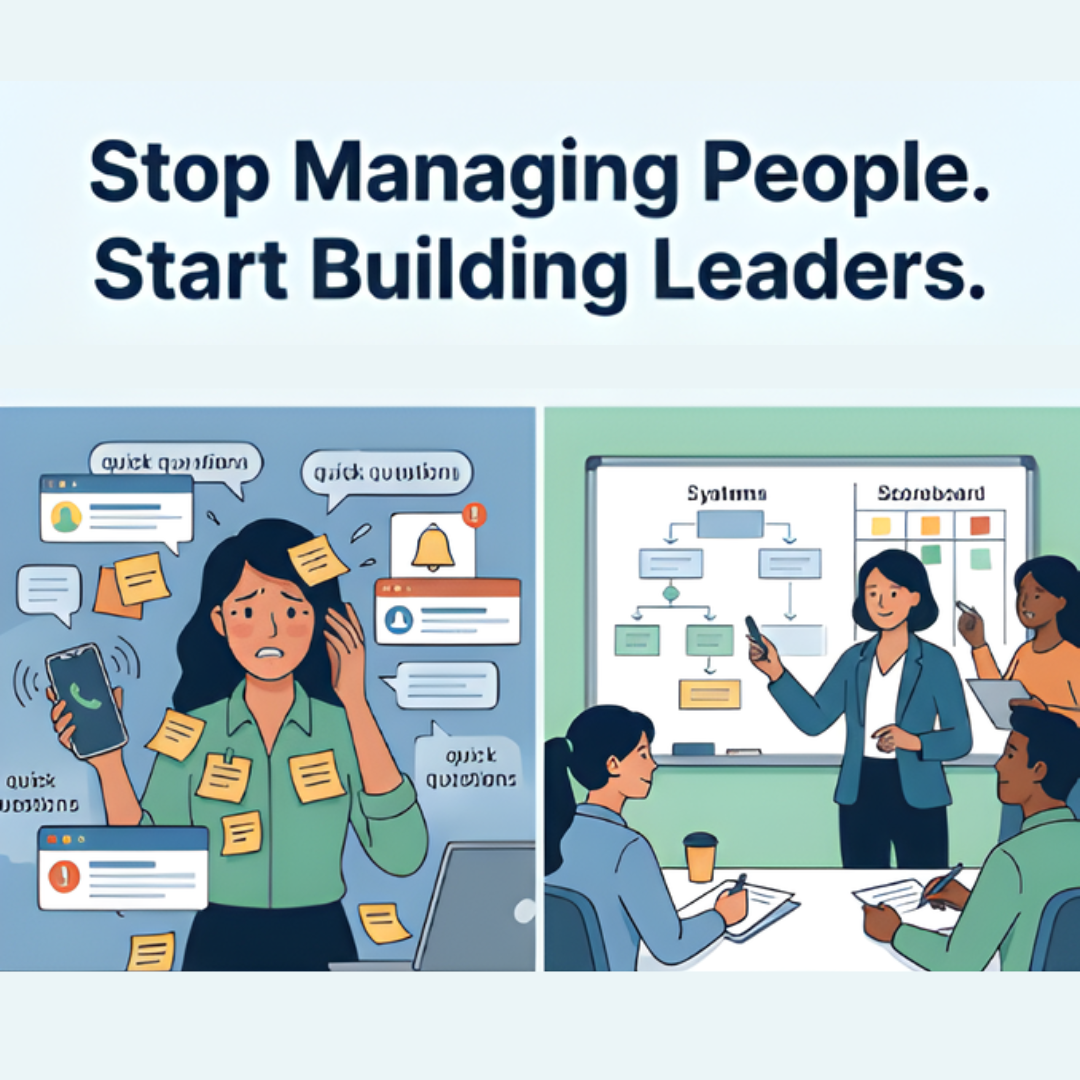
If you’re “managing people” all day… you’re probably building dependence
Let me guess: you started the business because you’re good at what you do. Then you hired people so you could finally breathe… and somehow you ended up busier than ever.
You’re answering questions all day. Fixing mistakes. Following up. Re-explaining. You’ve got good people… but the business still leans on you like a crutch.
Here’s the shift that changes everything: your business won’t grow past your leadership identity.
Not your job title. Not your org chart. Your identity—how you see your role every day.
In this blog, I’ll show you how to move from managing people to building leaders, so your team steps up without you carrying the whole load.
What is “Leadership Identity”?
Your leadership identity is the inner story you’re operating from:
- “I’m the one who needs to have the answers.”
- “If I don’t check it, it won’t be done right.”
- “It’s faster if I just do it.”
That identity creates a business where people wait for you.
The stronger identity is this:
- “My job is to grow people who can think and act.”
- “I don’t create results by rescuing— I create results by developing.”
- “I build a human team that can win without me in every decision.”
When you shift identity, your behaviour changes. And when your behaviour changes, your team changes.
The difference between managing people and building leaders
Managing people sounds like:
- “Just do it this way.”
- “I’ll take it from here.”
- “Why didn’t you ask me first?”
- “I need to approve everything.”
Building leaders sounds like:
- “What outcome are we aiming for?”
- “What options have you got?”
- “What do you recommend—and why?”
- “How will you prevent this next time?”
Managing creates compliance.
Leadership creates ownership.
And ownership is what gives you leverage, time, and consistent results.
5 signs you’re accidentally training your team to depend on you
If even one of these stings a bit, you’re not alone:
- You’re the escalation point for everything (even small stuff).
- Your team brings problems, not proposals.
- You redo work because “it’s easier than explaining.”
- Mistakes repeat because learning isn’t being captured.
- You’re the culture—when you’re stressed, everyone’s stressed.
None of that means you have a bad team.
It usually means you have a business that has outgrown your current leadership approach.
The identity shift: from “Manager” to “Leader Builder”
Here’s the simple reframe I give business owners:
Old identity: “I manage people to get tasks done.”
New identity: “I develop leaders to get outcomes achieved.”
This isn’t fluffy mindset talk. It’s practical. It changes how you speak, meet, delegate, and follow up.
Let’s make it real.
6 practical steps to start building leaders (without losing control)
1) Define what “a leader” means in your business
Don’t assume everyone has the same definition.
Write a short, clear standard like:
“A leader in our business takes ownership, communicates early, solves problems, and protects the customer experience.”
Keep it simple. Make it visible. Repeat it.
2) Stop delegating tasks—delegate outcomes
Instead of: “Send this invoice.”
Try: “Make sure the customer is billed correctly today and confirm payment terms are clear.”
Outcomes give people room to think. Tasks keep people small.
3) Replace “answers” with coaching questions
Use this 4-question rhythm in the moment:
- What’s the goal here?
- What have you tried?
- What options do you see?
- What will you do next—and by when?
At first, this feels slower. Then it becomes the fastest way to scale capability.
4) Create a leadership rhythm (so development isn’t accidental)
Most small business leadership development fails because it’s random.
Try this rhythm for 90 days:
- Weekly 1:1s (20–30 mins): priorities, roadblocks, development
- Weekly team huddle (30 mins): outcomes, numbers, focus, accountability
- Monthly skills focus (45 mins): one leadership skill (ownership, communication, decision-making)
Consistency beats intensity every time.
5) Make decision-making clear: what they own vs what you own
This is where micromanagement often hides.
Create three simple buckets:
- They decide (within agreed limits)
- They recommend, you decide
- You decide (rare, high-risk items)
When people know the playing field, they step up.
6) Reward ownership, not perfection
If you only praise flawless execution, you train people to play safe.
Instead, recognise things like:
- raising issues early
- proposing solutions
- learning from mistakes
- improving a system
That’s how leaders grow.
Simple scripts you can use this week
Here are a few “borrow and use” lines that reduce dependence fast:
- When they ask a question:
- “Good question—what do you think the best next step is?”
- When they bring a problem:
- “What are two options you’ve considered?”
- When something goes wrong:
- “What did we learn, and what system needs adjusting?”
- When you delegate:
- “What does ‘done’ look like? How will you keep me updated?”
Use calm tone. Be consistent. Your team will adapt.
How to know you’re building leaders (not just staying busy)
Look for these changes:
- People come with solutions, not just issues
- Deadlines get owned without chasing
- Standards improve because the team protects them
- You feel less like the “hub” of every wheel
- Leadership shows up when you’re not in the room
That’s leadership identity in action.
Let’s make this a conversation
If you’re a small or medium business owner, I’d love to hear from you:
What’s the biggest thing your team keeps bringing back to you—decisions, mistakes, or follow-up?
Drop a comment with one example, and I’ll reply with a practical way to shift it from dependence to ownership.
And if you want help building a clear leadership rhythm and developing leaders in your team, book a free strategy session here:
businesssteps.actioncoach.com
Turning Business Dreams into Reality.