
The “Good” Team Member Problem Nobody Wants to Talk About
Let me guess: you’ve got someone on your team who’s a weapon.
They’re loyal. They care. They’re the first to jump in when things go wrong. They know the customers. They know the shortcuts. They know where the bodies are buried (figuratively… hopefully). And when the pressure hits, they save the day.
On paper, that sounds like a dream employee.
In reality? They might be one of the biggest growth killers in your business—without meaning to.
This isn’t a hit piece on your best people. It’s the opposite. It’s a wake-up call for business owners who want to grow without burning out, and without being held together by a few hardworking humans acting like superheroes.
Because here’s the truth:
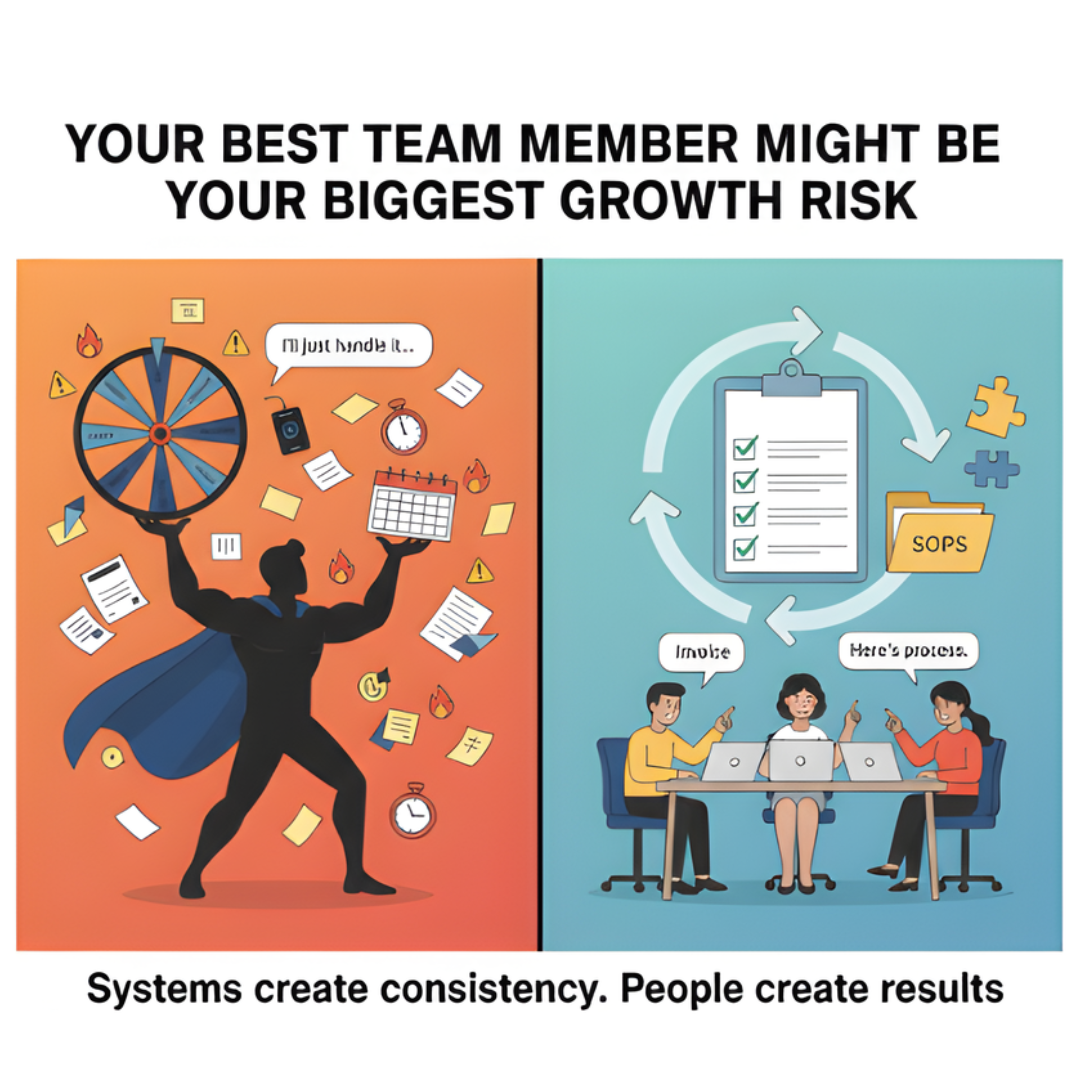
A business that relies on superheroes doesn’t scale. A business that runs on systems does.
In this blog, you’ll learn:
- Why “superstar” performance can hide serious operational risk
- The most common ways good team members accidentally block growth
- How to build business systems that create consistency, accountability, and freedom
- Practical steps to move from heroic effort to reliable delivery
Why Superheroes Feel So Good (Until They Don’t)
Superheroes are addictive because they create instant relief.
A customer issue pops up—your hero fixes it.
A job runs behind—your hero stays late.
A process breaks—your hero “just handles it.”
And as the owner, you breathe out. For the moment, the fire is out.
But the hidden cost is huge:
- The root problem never gets fixed
- The business becomes dependent on one person
- Other team members disengage or stop thinking
- You get stuck managing chaos instead of leading growth
Superheroes are often the reason a business can survive its early stages.
But the same pattern becomes a ceiling when you’re trying to scale.
The Growth Killers Hidden Inside “Good” Performance
Let’s unpack the most common ways great team members quietly limit growth.
1) Key Person Dependency: The Business Can’t Breathe Without Them
If one person holds the knowledge, relationships, and “how things get done,” you don’t have a team—you have a single point of failure.
This shows up as:
- “Only Jess knows how to do payroll properly.”
- “Only Mark can handle that client.”
- “If Sam is away, the wheels fall off.”
That’s not strength. That’s fragility.
In small business growth, key person dependency is one of the biggest risks to stability and profitability.
2) Bottlenecks: Everything Waits for the Hero
When the hero becomes the fixer, they also become the gatekeeper.
Work piles up waiting for their approval, their input, their magic touch. They end up with:
- Too many decisions
- Too many interruptions
- Too many urgent tasks
Meanwhile, projects slow down. Customers wait. Opportunities get missed.
This is how “busy” turns into stalled growth.
3) Inconsistency: Results Depend on Who’s Working That Day
If the business relies on effort instead of process, you’ll see uneven outcomes.
One day the customer experience is amazing. Next day it’s average. Then it’s a mess. Not because your team doesn’t care—because your business systems aren’t guiding consistent delivery.
Consistency is what builds:
- Repeat business
- Referrals
- Reputation
- Profit margins
And consistency comes from clear workflows and standard operating procedures (SOPs), not heroic effort.
4) Burnout: Your Best People Carry Too Much
Good team members often say yes too quickly. They pride themselves on being reliable. They don’t want to let you down.
But over time:
- Pressure becomes normal
- Long hours become expected
- Stress becomes culture
Eventually, your hero either burns out, checks out, or leaves.
And when they leave? It doesn’t just hurt—it exposes how much the business relied on them.
5) Learned Helplessness: The Rest of the Team Stops Owning It
Here’s the sneaky one.
When one person always saves the day, others learn a pattern:
- “If I wait long enough, they’ll fix it.”
- “I don’t want to mess it up, I’ll just handball it.”
- “That’s not my job—ask the hero.”
It’s not laziness. It’s conditioning.
A superhero culture can unintentionally create a team of passengers.
Systems vs Superheroes: What “Systems” Actually Mean
When I say business systems, I’m not talking about complicated software, massive manuals, or corporate red tape.
A system is simply:
“The way we do this here—so it gets done properly every time.”
Great systems are:
- Clear
- Simple
- Repeatable
- Easy to train
- Easy to improve
Think checklists. Templates. Step-by-step workflows. Handover points. Simple standards.
And most importantly…
Systems help good people do great work—without needing to be a superhero.
The Signs You’re Running a Superhero Business
Be honest—how many of these feel familiar?
- You hear “I’ll just do it” more than “Here’s the process.”
- Problems keep repeating, just with different faces
- Your best people are always “flat out”
- Tasks live in people’s heads instead of in a shared place
- Training feels slow and inconsistent
- You struggle to delegate because “it’s faster if I (or they) do it”
- When someone’s away, everything gets harder
If you nodded at a few of these, you’re not alone. This is a normal stage of growth.
The good news: it’s fixable—and it doesn’t require a full business overhaul.
How to Shift From Hero Dependence to Scalable Business Systems
Here’s a practical approach I use with business owners to improve operational efficiency without overwhelming the team.
Step 1: Identify Your “Hero Processes”
Ask:
Where do we rely on a specific person to get a result?
Common examples:
- Quoting
- Scheduling
- Handling complaints
- Ordering stock
- Invoicing
- Job handover
- Hiring and onboarding
Start with just one area that causes the most stress or delays.
Step 2: Capture the Minimum Effective Process
Don’t aim for perfection. Aim for usable.
Ask your hero:
- What triggers this task?
- What are the 3–7 key steps?
- What decisions happen along the way?
- What does “done properly” look like?
Create a simple checklist or one-page workflow.
This becomes your first SOP—your first step toward process improvement.
Step 3: Build Guardrails (Not Handcuffs)
A great system doesn’t trap people. It guides them.
Include:
- Standards (what “good” looks like)
- Timeframes (when it should happen)
- Quality checks (what must be confirmed)
- Escalation rules (when to ask for help)
This creates team accountability without micromanagement.
Step 4: Cross-Train So No One Is “The Only One”
The goal isn’t to make everyone do everything.
The goal is:
No task should live with only one person.
Cross-training protects your business, protects your people, and gives you options when you’re growing.
Step 5: Stop Rewarding Heroics (Start Rewarding Consistency)
This is a leadership moment.
If you only praise the person who stays late and “saves it,” you’re training the team to rely on chaos.
Instead, recognise:
- Preventing problems
- Following the system
- Improving the process
- Helping others learn it
That’s how you shift culture from firefighting to stability.
The Best Formula: Good Humans + Strong Systems
This isn’t systems or people.
It’s both.
People create results. Systems create consistency.
When you combine strong humans with clear business systems, you get:
- Better customer experience
- Faster onboarding
- Less rework and wasted time
- More reliable profit
- A calmer, more accountable team
- More time for you to lead, not rescue
That’s what a scalable business looks like.
Your Next Step: Pick One Process and Fix the Leak
If you want momentum, do this today:
- Choose one area where your business depends on a “hero”
- Write a simple checklist of how it should be done
- Share it with the team and improve it as you go
Simple. Practical. Real.
And if you want help choosing the right process (the one that will give you the biggest immediate lift), you can book a free strategy session through the contact form on businesssteps.actioncoach.com.
Let’s Build a Community in the Comments
I’d love to hear from you—and I reply to comments.
Which part of your business is most “superhero-dependent” right now?
Is it quoting, scheduling, customer issues, job handovers, or something else?
Drop your answer in the comments, and if you want, share:
- What is the recurring problem?
- Who tends to fall back on
- What you’ve tried so far
Chances are, other business owners are dealing with the same thing—and your comment might be the one that helps someone take their first step from chaos to control.