
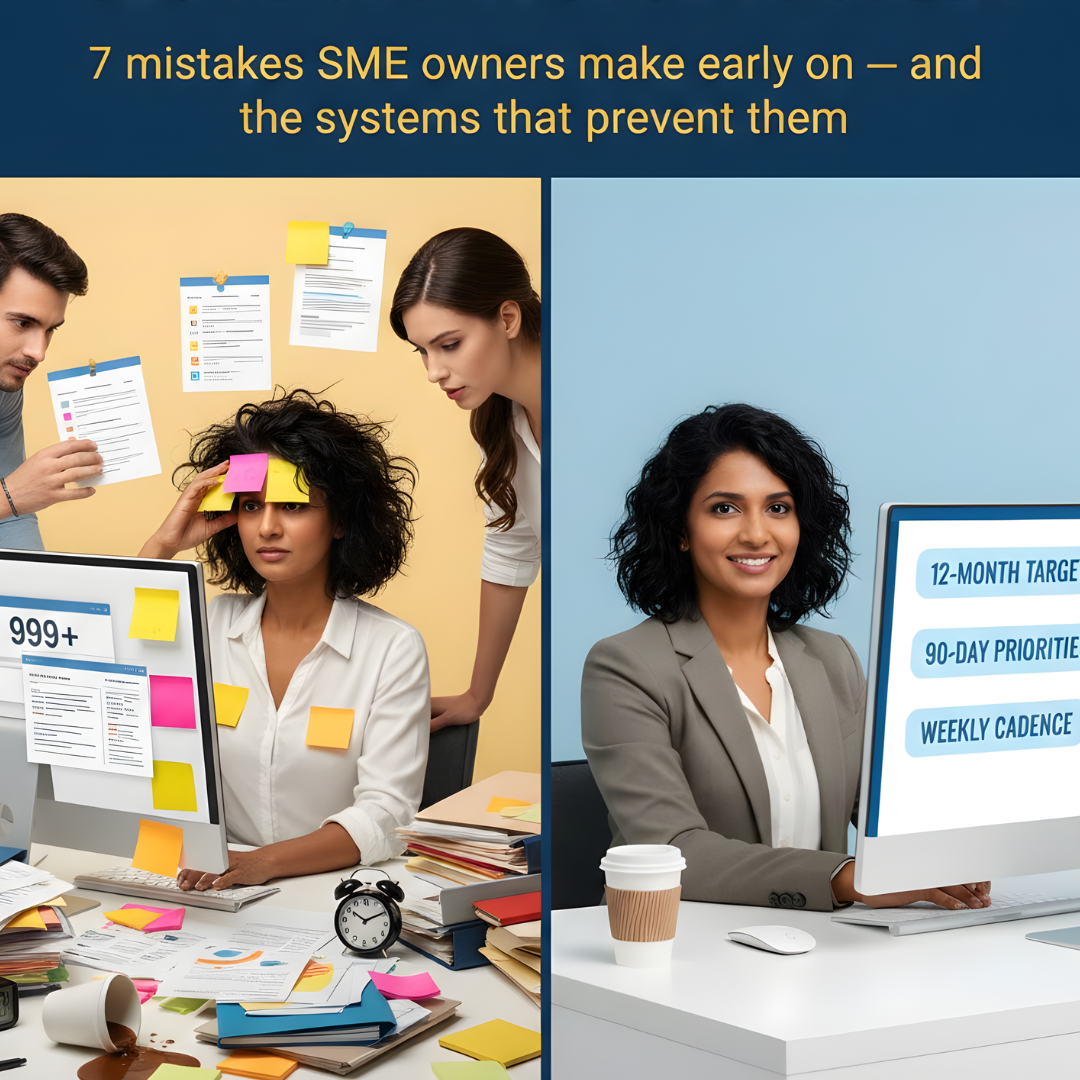
The 7 Biggest Mistakes SME Owners Make Early On (And the Systems That Prevent Them)
If you’re in your first five years of business, you don’t have a time problem.
You’ve got a focus problem.
Because right now it probably feels like this:
- You’re flat out… but not getting ahead.
- Your team keeps dropping the ball.
- Cash goes out faster than it comes in.
- And your “plan” is basically whatever fire is burning today.
And here’s the annoying part: you are working hard. You are showing up. You are trying.
But effort doesn’t guarantee results. Direction does.
I’m Phil Badura, and in this blog I’m going to walk you through the 7 most common mistakes SME owners make in their first five years—and more importantly, the simple systems that fix the cause (not just the symptoms).
One line to remember as we go:
Systems create consistency, people create momentum.
You need both if you want a business that grows without burning you out.
Growing pains are normal (but chaos doesn’t have to be)
The first five years are when you’re learning how to move from:
- operator to owner
- chaos to control
- “doing everything” to leading a team that delivers results
Most SME owners don’t struggle because they’re lazy. They struggle because they build the business on talent and hustle… instead of systems and leadership.
So let’s fix that.
Mistake #1: No clear direction (vision, targets, and a real plan)
If I asked you right now:
- Where do you want the business to be in 12 months?
- What are your revenue, profit, and cash targets?
- What does “winning” look like for the team?
If your answer is “Uh… bigger?”—you’re not alone. But you are at risk.
What this looks like day-to-day
- Everyone is busy, but priorities change daily
- Projects start, stop, start again
- Decisions get made based on pressure, not purpose
The system that prevents it (3 steps)
- Set clear 12-month targets: revenue, profit, cash, capacity
- Choose 3 priorities per 90 days: not 12, not “everything”
- Run a weekly rhythm: review priorities, blockers, and numbers
Think of it like GPS: you can drive fast, but if you don’t know the destination, you’ll still end up lost—just tired.
Mistake #2: Trying to do everything yourself (and calling it “standards”)
This is the classic SME trap: the owner becomes the bottleneck.
You’re the estimator, problem-solver, HR department, bookkeeper, quality checker… and somehow you’re also meant to be the leader.
You tell yourself, “It’s faster if I do it.”
Truth: it’s only faster today. It’s deadly long-term.
What it creates
- Team dependency
- Slow decisions
- Constant interruptions
- You can’t take time off without chaos
The system that prevents it (3 steps)
- Write your “Only I Can” list: it should be very short
- Assign ownership: who owns what outcome (not just tasks)
- Build decision rules: “If X happens, do Y”
Delegation isn’t losing control. It’s building capacity.
Mistake #3: Weak cashflow habits (profit on paper, panic in the bank)
Third mistake: confusing revenue with money in the bank.
A business can be “busy” and still be broke. Tight cashflow shows up everywhere:
- Stress at home
- Pressure at work
- Panic decisions
- Underpaying yourself
- Delaying tax, suppliers, or wages
The system that prevents it (3 steps)
- Weekly money rhythm: cash in, cash out, and runway
- Tighten receivables: invoice same-day, follow-up schedule, clear terms
- Know your key numbers: gross margin, labour %, overhead %, break-even
Cashflow is not a personality trait. It’s a system.
Mistake #4: Hiring too fast, hiring the wrong fit, or avoiding leadership conversations
Early-stage businesses often hire from urgency—not fit.
Or they keep the wrong person because replacing them feels hard.
But here’s the cost:
- Missed deadlines
- Rework
- Customer complaints
- Toxic culture
- You spending your day cleaning up mess
Let me say this plainly: your team doesn’t need more motivation. They need more clarity.
The system that prevents it (3 steps)
- Hire to a scorecard: attitude, skills, standards
- Set expectations early: “Here’s how we do it here.”
- Lead weekly: one-on-ones, feedback, recognition
Leadership isn’t a vibe. It’s a repeatable habit.
Mistake #5: No documented systems (everyone does it their way)
If your business relies on tribal knowledge—“just ask Dave”—you don’t have a business.
You’ve got a collection of habits.
What missing systems create
- Inconsistent quality
- Constant mistakes
- Training takes forever
- Customers get “hit and miss”
The system that prevents it (3 steps)
- Start with the top 3 pain processes: usually quoting, scheduling, handover
- Document the “best way” on one page: not a novel
- Train, audit, improve weekly: small tweaks compound fast
Say it with me: Systems create consistency, people create momentum.
Mistake #6: Inconsistent marketing and sales (feast or famine)
Mistake six is treating marketing like a tap you turn on only when you’re desperate.
Then you’re busy, so you stop marketing.
Then work dries up.
Then you panic and discount.
Then you repeat.
That’s not growth. That’s survival mode.
The system that prevents it (3 steps)
- Pick 2–3 lead sources you can do consistently
- Weekly pipeline rhythm: leads, follow-ups, quotes sent, conversion
- Systemise referrals: ask, track, reward
Consistency creates pipeline. Pipeline creates peace.
Mistake #7: No cadence of accountability (no scoreboard, no rhythm)
This one is the quiet killer: no rhythm.
No weekly meeting cadence.
No scoreboard.
No accountability.
So things drift. Standards slip. People assume. Problems grow.
The system that prevents it (3 steps)
- Weekly meeting rhythm with a fixed agenda: wins, numbers, priorities, issues, actions
- A simple scoreboard: 5–10 key numbers that predict success
- Clear actions: who does what by when
If you want a business that scales, you need a cadence that keeps everyone aligned—especially when you’re busy.
The Focus, Attention & Energy Reset (what to do from here)
If you’re in the first five years—or still operating like you are—here’s where your focus must go:
- Direction: clear targets + 90-day priorities
- Cash discipline: weekly money rhythm
- People leadership: expectations, feedback, accountability
- Systems: document the critical processes
- Cadence: meetings, scoreboards, follow-through
Stop asking, “What do I need to do today?”
Start asking, “What must we build so this stops depending on me?”
Because you didn’t start your business to feel trapped inside it. You started it for freedom—and with the right systems and leadership, you can earn that freedom.
Turning Business Dreams into Reality.
And remember: Systems create consistency, people create momentum.
Quick self-check: Which owner type are you right now?
This matters because different people get stuck in different places:
- Driver: moves fast, breaks things, needs clearer priorities and delegation rules
- Analytical: wants certainty, delays decisions, needs cadence + “good enough” systems
- Amiable: avoids hard conversations, keeps the wrong people too long, needs scorecards + weekly leadership habits
- Expressive: big vision, inconsistent follow-through, needs weekly rhythms + scoreboard to stay anchored
If you tell me which one you relate to most, I can help you tighten the systems that fit your style (without turning you into someone you’re not).
Want to build your next 90 days properly?
If any of the seven mistakes hit a little too close to home, here’s the good news: they’re fixable. Not with motivation. With structure.
If you want help diagnosing where you’re stuck, book a strategy session and we’ll map out the next 90 days properly.