
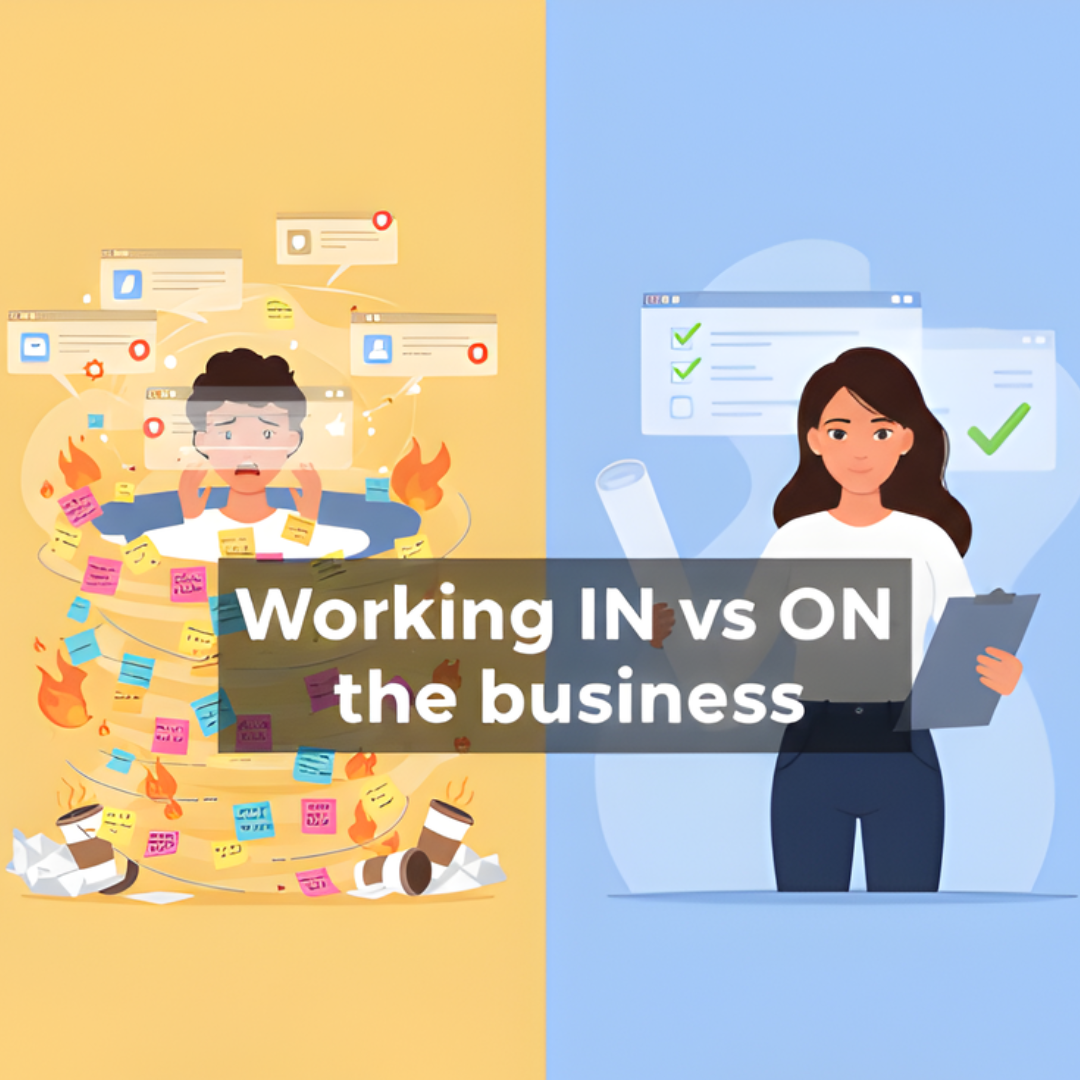
If You’re Always Busy… This Blog Is For You
Let me guess: your days are packed. You’re answering messages, handling client fires, doing the actual work, checking the numbers, fixing the website, chasing payments, posting content, and somehow you’re also supposed to “lead.”
And at the end of the day, you feel productive… but also weirdly stuck.
Here’s the truth I tell business owners (kindly, but directly): being busy is not the same as building a business. Busy can be a trap. It makes you feel useful while quietly keeping you small.
In this blog, you’ll learn:
- The real difference between working in the business and working on the business
- Why smart owners still get stuck in “do-it-all mode”
- The mindset shift that turns you into a builder (not just a worker)
- Simple, practical steps to create systems, delegate better, and free up CEO time
Think of this as a coaching session in blog form. I’ll ask you questions as we go—because clarity changes everything.
Working In the Business vs Working On the Business (In Plain English)
Working in the business = doing the work that produces today’s results
This is the day-to-day execution:
- delivering services
- managing staff tasks
- replying to customers
- packing orders
- putting out fires
- doing the admin
It keeps the business running today.
Working on the business = building the machine that produces results without you
This is design, leadership, and improvement:
- creating systems and processes
- training a team (or future team)
- improving pricing and packages
- refining your marketing strategy
- building repeatable sales processes
- tracking numbers that guide decisions
- planning capacity and hiring
It makes the business stronger next month, next year, and beyond.
Here’s an analogy:
Working in the business is cooking every meal. Working on the business is building a kitchen system so meals can be made faster, easier, and eventually without you being the only chef.
Both matter. The problem is when your business only survives because you’re constantly cooking.
The Busy Owner Problem: “If I Don’t Do It, It Won’t Get Done Right”
This is the most common mindset block I see with small and medium-sized business owners:
- “It’s faster if I just do it.”
- “No one can do it like me.”
- “I’ll delegate when things slow down.”
- “I can’t afford help.”
Let me coach you for a second:
1) “It’s faster if I just do it” is true… today.
But it’s expensive tomorrow. Because every time you “just do it,” you’re voting for a business that needs you forever.
2) “No one can do it like me” is usually a training problem, not a people problem.
If your standards live only in your head, of course, nobody meets them.
3) “I’ll delegate when things slow down” almost never happens.
Businesses don’t magically slow down. You decide to build capacity.
4) “I can’t afford help” might be true right now.
But then the question becomes: what must change so you can? Because if you’re the only engine, growth has a hard ceiling.
The Mindset Shift: From “Doer” to “Designer”
Here’s the shift that turns busy owners into business builders:
Stop asking: “What do I need to do today?”
Start asking: “What needs to exist so this is easier next time?”
That’s the builder question.
Busy owners chase tasks. Builders create repeatable ways to handle tasks.
Busy owners run on memory. Builders run on systems.
Busy owners rely on motivation. Builders rely on structure.
And yes—this takes intention. Because your brain will keep choosing short-term relief (do it yourself) over long-term freedom (build the process) unless you decide otherwise.
A Quick Self-Check: Are You Running a Business or Owning a Job?
Answer these honestly:
- If you disappear for two weeks, does everything stall?
- Do customers and staff always need you to move forward?
- Are you making decisions based on what feels urgent… not what matters most?
- Do you spend more time doing tasks than guiding direction?
- Are you exhausted but still unsure what to prioritize?
If you said yes to 2 or more, you’re not broken. You’re just at a stage where the business is demanding a new version of you.
How to Start Working On the Business (Without Ignoring the Real Work)
Let’s get practical. Here are the steps I use with business owners who feel trapped in the day-to-day.
Step 1: Create “CEO Time” (Even If It’s Just 60 Minutes a Week)
You don’t need a full day. Start with one protected block weekly.
Call it:
- CEO Hour
- Builder Block
- Systems Sprint
Rules:
- No client work
- No inbox
- No meetings
- No firefighting unless it’s a real emergency
Your job in this hour is to reduce future chaos.
If you’re thinking, “That’s impossible,” I’ll challenge you:
If you can’t find 60 minutes to build your business, your business is owning you.
Step 2: Do a Simple Time Audit (Track Only 5 Categories)
For one week, write your tasks under five buckets:
- Money-making work (sales + delivery)
- Admin (invoicing, scheduling, emails)
- Team management (training, checking, follow-ups)
- Marketing (content, outreach, partnerships)
- Fixing problems (firefighting, mistakes, confusion)
Then ask:
- What repeats every week?
- What drains you the most?
- What could be documented once and repeated?
- What should never require your brain again?
This is how you find your first system to build.
Step 3: Start With “Systems That Save You Weekly”
Don’t try to systemize everything. Start where you get a weekly return.
Examples of high-impact systems:
- How do you onboard a client
- How you handle inquiries and quotes
- How you deliver your service step-by-step
- How do you follow up for payment
- How you handle common customer problems
- How your team reports updates
A simple system can be:
- a checklist
- a template
- a script
- a short Loom video
- a one-page SOP (standard operating procedure)
Perfection is not the goal. Repeatability is.
Step 4: Delegate the “Low-Value, High-Frequency” Tasks First
If you’re overwhelmed, don’t delegate random things. Delegate strategically.
Look for tasks that are:
- frequent
- predictable
- easy to explain
- not worth your hourly value
Examples:
- scheduling
- Basic customer replies
- posting prepared content
- Invoicing and reminders
- organizing files
- sending onboarding emails
A coaching note:
Delegation isn’t dumping tasks. It’s transferring outcomes with clarity.
Which leads to the next step…
Step 5: Upgrade Your Delegation With One Tool: “Definition of Done”
Most delegations fail because the owner says:
“Can you handle this?”
…and the team hears:
“Do your best.”
Instead, give a clear “Definition of Done.”
Example:
- What does “done” look like?
- What are the steps?
- What’s the deadline?
- What format should it be in?
- What should they do if they get stuck?
This reduces back-and-forth and protects your mental space.
The Real Goal: A Business That Doesn’t Need Your Constant Attention
When you start working on the business, you’re building:
- clarity (everyone knows what “good” looks like)
- consistency (clients get a reliable experience)
- capacity (more output without burning you out)
- scalability (growth without chaos)
This is how small businesses grow into stable businesses.
And here’s a detail people don’t say enough:
You don’t need to scale to be successful.
But you do need to design a business that supports your life instead of consuming it.
Common Objections (And the Coach Answer)
“But I’m not big enough for systems.”
Systems aren’t for big companies. Systems are for reducing repeated mistakes. Even a solo business needs that.
“I tried delegating, and it failed.”
Then you didn’t fail—your process did. Fix the process, not your belief in delegation.
“I don’t have time to build this.”
You don’t have time not to. If you keep doing everything, your future stays crowded.
A Simple Weekly Builder Plan You Can Start This Monday
If you want a starting point, do this for the next 4 weeks:
Week 1: Track tasks + choose one repeat problem to solve
Week 2: Build a checklist/SOP for it
Week 3: Delegate it (or automate parts of it)
Week 4: Review what broke, adjust, and lock it in
That’s it. Build one brick at a time.
Let’s Make This a Conversation (Comments Welcome)
Now I want to hear from you—because this is where real growth happens.
In the comments:
- What’s the one task that eats your time every week?
- What’s one part of your business you wish ran without you?
- Are you currently more “busy” or more “building”?
I read the comments, and I respond—so if you share what kind of business you run (service, retail, agency, trades, etc.), I can give a more specific suggestion.
Closing: Busy Doesn’t Mean Built
Working in your business is honest work. It’s how you got here. But if you want a business that lasts—and a life that doesn’t feel like constant catching up—then it’s time to shift:
From doer to designer.
From busy to building.
From “I handle everything” to “I build it so it runs.”
You don’t need more hustle. You need a better structure.